To start:

This problem involving bathrooms originates in the "social construction”of sex. This is defined by how “sex is socially shaped through human agency” (Overall 73). 

The social constructions and the reshaping of the definitions of sex are important because how society views “sex” affects how bathrooms are viewed.

The issue of having “sex segregated” bathrooms is defined by “the socially-enforced confinement of human individuals to particular places, institutions, roles, or responsibility on the basis of... their sex” (Overall 75). 

Having “sex segregated” bathrooms is socially enforced by gender norms. Gender norms are the way society expects a person of a certain gender to behave or look. 

It is important to desegregate bathrooms and “eliminate the significance of the concept of sex in the vast majority of situation[s]” (Overall 87).

http://images.neopets.com/items/toilet_rainbow.gif 

Why this is important:

Gender Specific Bathrooms VS.

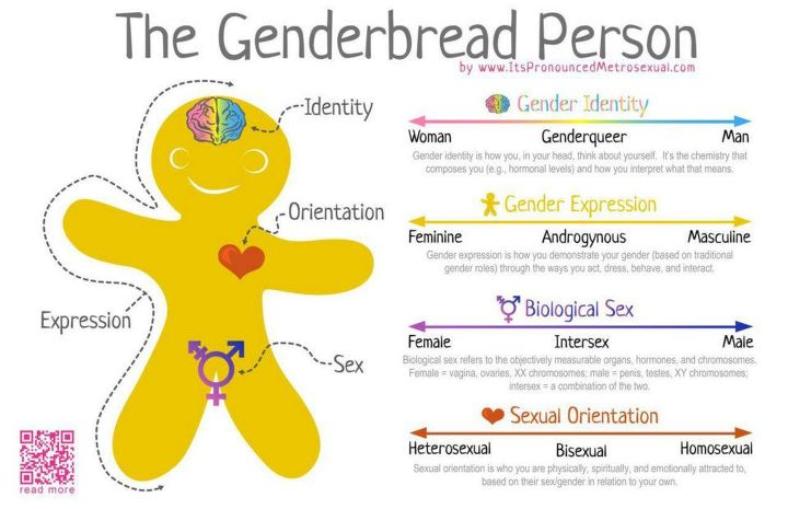
      It can be hard to get unisex bathrooms put into service in different facilities, as many people see gender as a binary with only two options, male or female.

As you can see in the graphic above, gender is much more complex than the two categories many believe it is limited to.

A cisgender person is someone who defines themselves as only male or female. When most cisgender people think about using the bathroom, they do not worry about which bathroom they should use.


It is easy for most people to determine which room to use based on their sex. This decision is not so clear cut for a person with a gender identity that differs from their sex. 


 Institutions “…are social organizations that involve established patterns of behavior around particular purposes” (Shaw and Lee 49). Bathrooms are needed in every institution, which means they exist in all of the major institutions such as family, marriage, government, education, science, health and medicine, military, and sports. In nearly all of these institutions, sex-segregated restrooms are enforcing norms.

In all of these institutions, men and women have certain roles and breaking these roles often end in punishment. This also applies to the use of bathrooms. 

If someone uses a bathroom labeled for the opposite sex by mistake or because of an emergency, they are often criticized and punished verbally and/or physically by the society or peers. 

Bathrooms of men and women in some educational and business buildings are located  far away from each other, and often, these buildings have more men’s bathrooms than they have women’s bathrooms. This demonstrates how these institutions create inequality between different types of gender.

Institutions are in place to make lives better and easier to live. In reality, “…institutions function to support systems of inequality and privilege” (Shaw and Lee 50). 

  Gender Neutral Bathrooms

Providing unisex bathrooms gives extra comfort, privacy, and safety “for gender- and sex- nonconformists, including passing women and men, transsexuals, transgender men and women, and those who do not identify permanently with any gender or sex” (Overall 85).   

These bathrooms also provide cisgender men and women with extra privacy and more bathroom facilities that can be used by anyone.


Gender identity concerns how one feels internally about one’s own gender, and transgender people may feel uncomfortable or afraid of sharing bathrooms with others. 


It is often difficult to convince an institution such as a school or workplace to implement a gender neutral public restroom. These types of restrooms are important to transgender people especially because transgender people are often subject to embarrassment, harassment, or even assault or arrest by others offended by the presence of a person they interpret as being of another gender.


Providing unisex bathrooms also provides comfort for parents who wish to accompany their opposite-sex child to the bathroom, and people with disabilities who may have an opposite-sex helper (Overall 85). 

With unisex or gender neutral bathrooms, all people are able to use them, regardless of their gender identity, and as a unified society, we will be able to begin to break down the notion of inequality. 

Unisex bathrooms are necessary in order to make and aspect of daily life more comfortable and convenient for men and women, and to help further equality

According to the American Restroom Association (2006), a single-stall restroom offers flexibility and privacy, serving “people with shy-bladder and those in the transgender community.”

Check these stories out! : 

http://www.youtube.com/watch?v=bNZ8VIdySQg  

http://www.youtube.com/watch?v=wahE2b3aJh8 

On NIU Campus:


Important on Campus:

The issue of gender neutral restrooms is especially important on our campus. Most buildings on campus do not have any unisex bathrooms. Although there are several single occupancy restrooms at NIU, almost all of them have gendered signs. 

Out of more than 70 buildings on the NIU campus, the Holmes Student Center and the Women’s Resource Center are the only two that have unisex restrooms. Northern Illinois has the potential to be listed along with top universities such as the University of Chicago and the University of Illinois at Chicago by implementing gender neutral restrooms. Both UIC and the University of Chicago offer gender neutral/single-occupancy restroom facilities in academic settings as well as in campus housing. 

Northern Illinois University could be listed among the nationally renowned universities mentioned above that are striving for equality and to make a safer environment for students and staff. 

The reasons listed above each apply to our very diverse campus, which is keen on promoting diversity and acceptance. Acceptance can be further demonstrated by creating gender neutral restrooms to promote safety, comfort, and privacy for all individuals, regardless of gender identity, family status, or disability.  

 http://www.niu.edu/index.shtml 

 Feminist Action:

Reforming the bathroom situation here at Northern Illinois University is a form of feminist action.  We are bringing awareness to the population of NIU and seek reform to eliminate the concerns of safety and inconvenience when using the restroom.  

We are approaching this issue with efforts to create a social movement on campus to make the problems with the current restroom situation known to the people that can physically change the restrooms by signage or hardware. Our efforts will be heard and they will be acknowledged.    

We need the facilities department to understand why reform is necessary for all types of people not just what social constructs deem necessary.  

Feminism is not just for women, its for everyone; gay, straight, bisexual, transgender, genderqueer, men, mothers, fathers, mentally or physically disabled, children, elderly, the list goes on.  Feminism focuses on breaking societal norms and promoting strength and acceptance to all walks of life and by simply making someone feel comfortable in the most vulnerable of times is surely a form on feminism action.   


This free website was made using Yola.

No HTML skills required. Build your website in minutes.

Go to www.yola.com and sign up today!

Make a free website with Yola